CD3 stands for “Cost of Delay Divided by Duration.”
It is a prioritization metric used in Agile (specifically in Kanban and SAFe) to determine which feature or task should be done first to maximize economic value.
Think of it as the “Bang for your Buck per Minute” metric. It helps you identify high-value tasks that can be done quickly, preventing you from getting stuck on “high value but extremely slow” projects.
1. The Formula
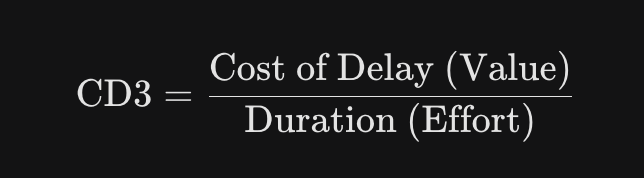
- Cost of Delay (CoD): How much money/value do you lose (per week/month) if you don’t have this feature? (This represents Urgency + Business Value).
- Duration: How long will it take to build?
The Rule: The item with the highest CD3 score gets priority.
2. A Simple Example
Imagine you have two features to build, but you can only work on one at a time.
| Feature | Value (Cost of Delay) | Duration (Time to Build) | CD3 Score |
| Feature A | $10,000 / week | 10 weeks | $1,000$ |
| Feature B | $5,000 / week | 2 weeks | $2,500$ |
Decision:
- Traditional Manager: might pick Feature A because it has “higher value” ($10k vs $5k).
- Agile Manager (using CD3): picks Feature B.
- Why? Feature B delivers value faster relative to the effort required. By doing B first, you start earning that $5,000/week much sooner, and you clear the pipeline quickly to start on A.
3. Why is this critical?
If you always pick the “most valuable” thing (Feature A), you might clog up your development pipeline for months. CD3 forces you to look for Quick Wins—high-value items that are short to implement.
4. Note on Terminology (WSJF)
In the Scaled Agile Framework (SAFe), this concept is often called WSJF (Weighted Shortest Job First).
- WSJF is the concept (Weighting jobs by shortness).
- CD3 is the specific mathematical way to calculate it.
- For exam purposes (PMI-ACP/PMP), they are effectively the same strategy: Do the short, valuable things first.